AI agent vs automation vs chatbot: which do you need?
Chatbots answer, automations follow fixed steps, and AI agents decide their own. How to tell which one your problem needs, and how to spot an "agent" that isn't one.
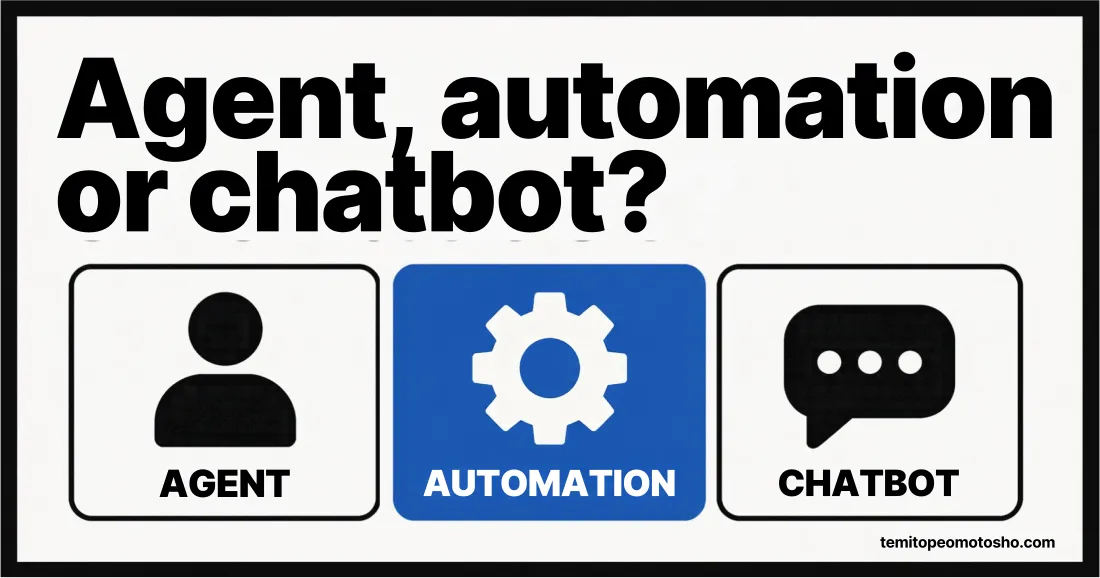
Everyone is selling AI agents right now. Some of them are agents. Plenty of them are chatbots with a new label and a bigger invoice.
If you run a business and you're being pitched, the worry is fair: am I paying agent prices for something that's really a chatbot? You're not the only one asking. A Hacker News thread titled "Are there any real examples of AI agents doing work?" is mostly people saying they can't find many, and that a lot of what gets called an agent is workflow automation with better marketing.
So here are working definitions, a test you can run on your own problem, and some examples. I'll be honest up front: most of the time, the answer is not an agent.
What chatbots, automations and AI agents actually are
The words get used loosely, so it helps to pin them down.
- A chatbot answers questions. You ask, it replies. It might draw on your help pages, but it doesn't go and do things in your systems.
- An automation follows a path someone wrote down. Anthropic, the company behind Claude, describes workflows as "systems where LLMs and tools are orchestrated through predefined code paths". The AI might read an email or write a summary at one step, but the order of steps is fixed in code.
- An agent decides its own steps. In the same piece, Anthropic defines agents as systems "where LLMs dynamically direct their own processes and tool usage". You give it a goal and some tools, and it works out what to use and in what order.
OpenAI draws the line in a similar place. Its practical guide to building agents describes an agent as a system that uses a model to manage the workflow and make decisions, with access to tools, operating within clearly defined guardrails. It is blunt about the rest: simple chatbots and single-turn tools "are not agents".
The difference that matters to you isn't how clever the AI is. It's who decides what happens next: you, in advance (automation), or the model, while it runs (agent).
Most business problems are workflows
Describe most everyday business problems in plain words and they sound like this. An email comes in, a person reads it, copies the details into a system and sends a reply from a template. Or a document arrives and someone pulls out the same ten fields every time.
That's a workflow. The steps are known. The AI's job is the fuzzy bit in the middle (reading messy text, pulling out fields, drafting a reply), and ordinary code handles the rest.
Anthropic's own advice is to find "the simplest solution possible, and only increasing complexity when needed. This might mean not building agentic systems at all." It also notes that "agentic systems often trade latency and cost for better task performance". In plain terms, an agent calls the model more, takes longer and costs more each time it runs. Sometimes that trade is worth it. Often it isn't.
A workflow also fails in more predictable ways. When step three breaks, you know it was step three. When an agent goes off course, someone has to read the logs to work out what it decided and why. That matters a great deal a few months after launch, which is where most AI projects actually come unstuck.
When are AI agents worth the extra cost?
Agents earn their keep when the inputs vary so much that you can't write the path down in advance. Anthropic describes this as "open-ended problems where it's difficult or impossible to predict the required number of steps". OpenAI's guide points at similar territory: work that needs nuanced judgement and handles lots of exceptions, rulesets that have become unwieldy, and tasks that rely heavily on unstructured information like documents and conversations.
If your honest description of the job is "it depends, every case is different, and whoever does it has to look things up in three places before deciding", that's where an agent starts to make sense.
A three-question test
Before you buy or build anything, answer these about the specific task. Not "customer service" in general, but one job someone does every week.
- How predictable are the inputs? If most cases look alike, a workflow will do. If every case needs its own investigation, consider an agent.
- What does a mistake cost? If an error is cheap and easy to undo (a draft someone reviews before it goes out), you can afford more autonomy. If it's expensive or irreversible (a refund, a message to a customer, a change to live records), keep the steps fixed and put a human approval in front of the risky ones.
- How much volume is there? A task that happens five times a week might not need AI at all. A task that happens hundreds of times a day justifies more engineering, and the per-run cost of an agent starts to add up.
Roughly: predictable inputs, costly mistakes or high volume all point towards a workflow. Varied inputs, cheap mistakes and moderate volume are where an agent can pay off. And if it's mostly people asking the same questions, a chatbot on top of good documentation may be all you need.
Examples for a small or medium business
These are illustrations, not case studies.
- "Answer customer questions about opening hours, delivery areas and returns." Chatbot. The answers live in your documents and nothing needs doing in your systems.
- "When an order form comes in, check it, add it to our system and send a confirmation." Automation. The steps are the same every time. The AI reads the form and code does the rest.
- "Sort incoming supplier invoices, pull out the totals and flag anything that doesn't match the purchase order." Automation with AI in the middle. Reading the invoice is fuzzy, the matching is rules.
- "Work out why this customer's account looks wrong: check their orders, the payment records and the support history, then write up what happened." This is where an agent makes sense. You can't know in advance which records it will need or how many steps it will take.
When I integrated Claude into SubTrada, a procurement platform I built for UK construction, the jobs were specific: review a drawing, extract metadata from a bulk upload, do a quantity takeoff. Each has a clear input and a clear output. That shape of problem rarely needs a model choosing its own route.
How to spot agent washing
Gartner has a name for the relabelling problem: "agent washing". In June 2025 it predicted that over 40% of agentic AI projects will be cancelled by the end of 2027, because of escalating costs, unclear business value or inadequate risk controls. It also estimated that only about 130 of the thousands of vendors selling agentic AI are real, with many of the rest rebranding assistants, robotic process automation and chatbots.
If you're being sold an agent, ask:
- Which steps are fixed, and which does it decide for itself?
- Which systems can it actually take actions in, not just read from?
- What happens when it's unsure or wrong, and who gets told?
- What does it cost per run, and per month at our volume?
- Can you show me a log of a real run, step by step?
If the answers describe fixed steps, that's fine. It might be exactly what you need. Just pay automation prices for it.
Write the task down before you choose
Here's the exercise I'd do first. Write the task out in plain steps, as if you were explaining it to a new hire on their first day.
- If you can write every step, build a workflow.
- If you keep writing "it depends", circle those parts. Those are the only bits that might need an agent, and often a single AI step inside a workflow covers them.
- If the task is really "answer the same questions again and again", start with a chatbot and better documentation.
A workflow with one or two AI steps inside it is a perfectly good outcome. It's cheaper to run, easier to test and much easier to fix when something changes.
If you want a second opinion on which one you need, send me what you're building.
Building something with AI?
I'll send you a structured plan with scope, phases and a timeline, built to survive month three.