What is agentic AI? A plain-English guide for founders
Agentic AI is AI that plans and takes actions, not just writes text. What it means, where it works today, where it's still a demo, and what the "95% of pilots fail" headline really says.
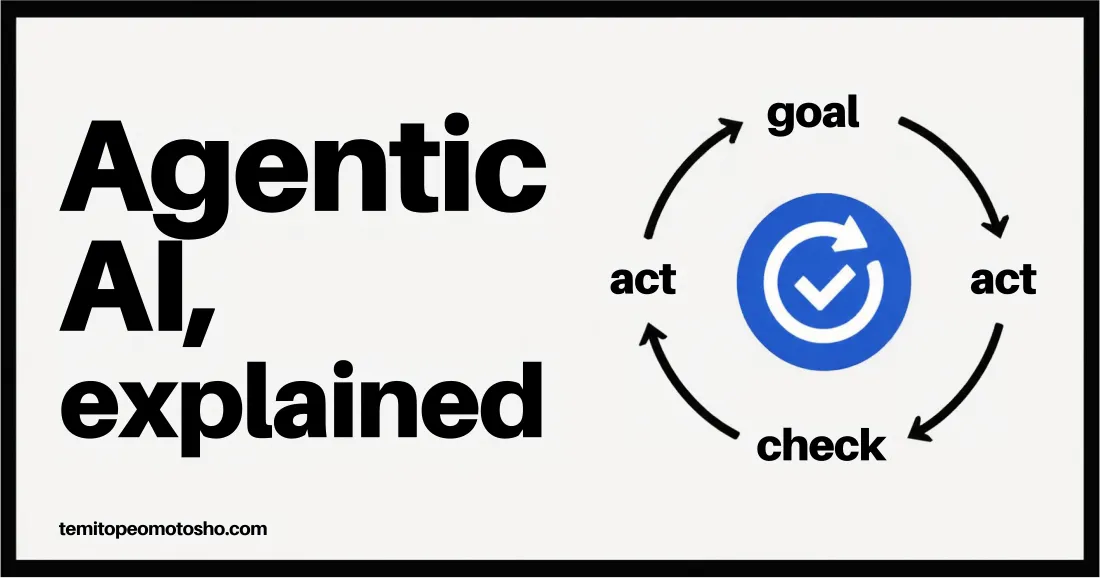
If you've read three articles about agentic AI this month and come away feeling slightly behind, you're in good company. The term is everywhere, the demos look impressive, and it's hard to tell from the outside which parts are real.
So here's the plain version. What agentic AI is, how it differs from the AI you've probably already used, where it's genuinely useful for a small business today, and where it's still mostly a demo. I'll also look at that "95% of AI pilots fail" headline, because it says something different from what most people take from it.
What is agentic AI, in plain English?
Agentic AI is AI that works towards a goal by taking actions, rather than just producing a piece of content and waiting for you.
IBM puts the contrast neatly. Generative AI "generally responds to an input and waits for further direction. It is primarily reactive." Agentic AI, by comparison, "can proactively work toward a goal", and you can give it a broader objective instead of spelling out every step.
Anthropic, the company behind Claude, draws a similar line in its guide to building effective agents. It describes agents as systems "where LLMs dynamically direct their own processes and tool usage, maintaining control over how they accomplish tasks."
The important words there are "tool usage". An agent is connected to things: your inbox, your calendar, your database, a search engine. It decides which of those to use, uses them, looks at the result, and decides what to do next.
Agentic AI vs generative AI: who takes the next step
A simple way to feel the difference is to take one task and watch who does the work.
Say a customer emails asking where their order is.
- With generative AI, you paste the email into a chat window, ask for a polite reply, then go and look up the order yourself, fill in the details and send it. The AI wrote some text. You did everything else.
- With agentic AI, the system reads the email, looks the order up in your order system, checks the courier's tracking, drafts a reply with the real status, and either sends it or puts it in a queue for you to approve.
Same underlying model, very different job. Generative AI creates. Agentic AI plans and acts.
That's also why agentic systems carry more risk. Text on a screen can't do much harm until a person acts on it. A system that can send emails, change records or issue refunds can.
Autonomy is a dial, not a switch
The most useful idea I can give you is that "agentic" isn't all or nothing. You choose how much the system is allowed to do on its own, and you can turn that up over time.
A rough scale looks like this:
- Suggests. The AI proposes what to do. A person does it.
- Drafts. The AI prepares the action (the email, the record update) and a person approves each one.
- Acts on the low-risk things. The AI handles routine cases itself and hands anything unusual or high-value to a person.
- Acts alone. The AI completes the task end to end, and people review the logs afterwards.
In my view most business systems should sit at level two or three, and that's not a failure of ambition. Anthropic's guide describes agents that "pause for human feedback at checkpoints or when encountering blockers", which is exactly the middle of that dial. You start low, watch what it does with real inputs, and only move it up once you trust it on the cases that matter.
Where agents work today, and where they're still demos
Plenty of people are sceptical, and not without reason. A Hacker News thread asking "Are there any real examples of AI agents doing work?" is full of people saying much of what's called an agent is workflow automation with a new label.
My honest reading is that agents work best when the job is narrow and the output can be checked. They struggle when the job is vague and nobody is checking.
Where they tend to hold up:
- A single, well-defined task with a clear finish line.
- A small set of tools, each with limited permissions.
- Output that a person or a rule can check before anything important happens.
Where they're still mostly demos:
- The "AI employee" that runs a whole department.
- Long chains of unsupervised steps that touch money, customers or legal commitments.
- Anything where a wrong answer is expensive and nobody would notice until later.
Anthropic's own advice, from a company that sells the models, is to look for "the simplest solution possible, and only increasing complexity when needed. This might mean not building agentic systems at all." If your problem follows the same steps every time, a plain automation is usually cheaper and more reliable. I've written about how to tell an agent, an automation and a chatbot apart if you want the decision in more detail.
Agentic AI examples for a small business
These are illustrations of the shape of a good first project, not case studies.
- Inbox triage. An agent reads incoming enquiries, works out what each one is, looks up the customer, and routes it to the right person with a short summary. Nothing goes out without a human.
- Supplier paperwork. An agent reads invoices and delivery notes, finds the matching purchase order, and flags anything that doesn't line up. A person approves each payment.
- Internal questions. Staff ask "what did we agree with this client last year?" and an agent searches your documents and records, then answers with links to where it found the information.
Each one is narrow, touches a few systems, and keeps a person in charge of anything that can't be undone.
What about "95% of AI pilots fail"?
You've probably seen this one. It comes from MIT NANDA's report "The GenAI Divide", published in July 2025. Virtualization Review's summary reports that "95% of organizations are seeing no business return", based on more than 300 publicly disclosed AI initiatives, 52 structured interviews and 153 survey responses from senior leaders.
Two things are worth knowing before you let that number put you off.
First, the authors don't blame the models. According to the same summary, they say "the core barrier is learning rather than infrastructure, regulation, or talent", and point to "brittle workflows, weak contextual learning, and misalignment with day-to-day operations". In other words, the tools didn't fit the way people actually work, and didn't get better with use.
Second, the figures are self-reported and drawn from initiatives organisations were willing to talk about. It's a useful signal, not a precise measurement.
The lesson I take from it is about implementation. Pick a real process, fit the system to how that process actually runs, and plan for who looks after it once it's live. That last part is where most projects really fail.
So are you falling behind?
Probably less than it feels. The headlines make it sound as if everyone else has this sorted, but the research above suggests most organisations haven't. The sensible way in is one boring, specific task.
If you want to start, do this:
- Pick one process that happens often and wastes real time.
- Write down its steps, and mark the ones that need judgement.
- Decide where on the autonomy dial you're comfortable starting (level two is a good default).
- Work out how you'll know if it's getting things wrong.
If you'd like help working out whether an agent is the right fit for that process, send me what you're building.
Building something with AI?
I'll send you a structured plan with scope, phases and a timeline, built to survive month three.